

The Battle of the Bogside: The event that sparked 'The Troubles'
- May 8, 2024
- 6 min read
It was the summer of 1969. Neil Armstrong would be the first man on the moon. John Lennon and Yoko stayed in bed for world peace in Amsterdam, and Charles Manson and his disciples would go a murderous rampage in Los Angeles. But back in the country Northern Ireland, tensions were rising, and trouble was brewing.

The province known as Northern Ireland was only 48 years old in 1969, since the partition of the Island of Ireland in 1921 after three years of bloody war being the Irish Republican Army (IRA) and the British Forces. The Northern Irish state would be born and would be home to a mainly Protestant, Unionist majority, proud of their British heritage and would do their upmost to ensure that Northern Ireland would maintain as part of the United Kingdom. The mainly Catholic, Nationalist community would be a minority and felt discriminated against in many aspects of society including housing, job prospects and voting rights.
In the majority Catholic City of Derry, Nationalists felt the brunt of the Unionist Governments rule. Despite having 36,000 residents compared to the 17,000 Unionists in the 1960’s, The Unionists led the way due to the careful division of electoral wards that saw them have 12 councillors compared to the Nationalist’s 8.
In response to this Nationalist’s would form the Northern Ireland Civil Rights Association (NICRA), citing inspiration from Martin Luther King’s activism in the United States to grant civil rights to the African American community. NICRA would hold a series of marches in 1968 and 1969 that would be met with severe tension between the Catholic and Protestant communities as Civil War seemed inevitable to everyone looking on. The Unionist’s were of the idea that NICRA was really a front for the IRA and suspected of them of trying to stir up support to overthrow the Stormont Government and seek Irish reunification.
As the summer of 1969 edged closer, the sectarian violence in the cities of Derry and Belfast only intensified. April 1969, saw what is argued to be the first casualty of ‘The Troubles’. Catholic civilian Samuel Deveney would be beaten to death by the Royal Ulster Constabulary (RUC) as they began to lose their grip over the ever-escalating situation. Following on from this on the 12th of July – a day Unionists celebrate the Battle of the Boyne of 1690 – riots spread across the country as sectarian clashes erupted where Protestant marches preceded in community intersections. This would be the first time that families living on the wrong side of the sectarian divide would flee for their safety and signified that tensions would come to a head.
All eyes pointed to the 12th of August and the Loyalist March by the Apprentice Boys of Derry. It was feared that 15,000 members would preside dangerously close to Nationalist areas, and particularly the Bogside area. A Republican stronghold that would defend itself in response to any attack.
The battle lines were drawn and on the afternoon of the 12th of August 1969, the Battle of the Bogside would commence but no one present would be able to grasp that thirty years of bloody war was just around the corner. After projectiles were thrown by Apprentice Boys members from Derry’s wall into the Bogside area below, they were met by fierce resistance by the Nationalist defenders who vowed to defend their community.
The RUC would be caught in between two sides hellbent on driving each other out from their positions, as petrol bombs were exchanged from their respective positions. Nationalists were using any high ground to their advantage and the Rossville Street flats would be their staging ground to reign petrol bombs onto the RUC below.

The RUC would suffer heavy casualties, and this is where the first escalations would come. With poor protection and no experience in trying to control crowd trouble, the RUC would be dragged into a gruelling day of conflict with the Nationalist community. Officers from across the province were sent in, in an attempt to quell the violence but to no avail, a unit from County Down brought 59 officers, 43 of them would leave the Bogside injured.
Many young, Nationalist rioters that day would be inspired by the events that were unfolding before their eyes. Many of the rioters would’ve been too young to have participated in the Border Campaign of the late 1950’s undertaken by the IRA. Since that failed campaign, the IRA would largely disappear from guerrilla warfare action and focus on a Marxist-Leninist Political ideology in order to gain their 32 County Irish Republic. This was felt by the Nationalist communities who felt under siege by Loyalists who questioned the IRA’s legitimacy as they felt let down by their lack of visibility during the sectarian violence.
Many of the young men and women present in the Bogside would later join the Provisional IRA, a break away from the Old IRA, as they seeked an armed resolution to drive the British out of Ireland. One man who would later to become a main leader in the Provisional IRA and Northern Irish politics, would be Martin McGuinness. He was present at the Battle of the Bogside and would be an introduction into a life of armed conflict and politics. In Peter Taylor’s book: Provos – The IRA and Sinn Fein – he described McGuinness appearance at the Battle of the Bogside as ‘The beginning of his political education’. This would be the same for thousands of Nationalists across Northern Ireland.
As day turned into night and well into the 13th of August, with no sign of either side relenting, it was confirmed that the army would be deployed within 24 hours to put an end to the violence once and for all. But it would be a third party who would add fuel to the fire by making statements that would enrage the Unionists.
Taoiseach for the Republic of Ireland, Jack Lynch would address the Irish nation by saying the Irish Army would stage field hospitals for injured Nationalists, across the border in County Donegal. He criticised the Stormont Government grip of the situation and vowed to step in to help their Nationalist counterparts in the North. He proclaimed:

“The reunification of the national territory can only be the permanent solution for the problem, it is our intention to request the British Government to enter into early negotiations with the Irish Government to review the present constitutional position of the Six Counties of Northern Ireland.”
This answered Loyalist’s greatest fears and it was their belief that the fields hospitals but were instead a starting point for the Irish Army’s invasion to reclaim the Six Counties of Ulster and be under a 32 County Irish Republic.
These words only increased the volleys of violence as the riots reached its peak. This would be where we’d finally see some sort of intervention from a military force. The B-Specials, largely made up of Protestant Military Reserves tasked with keeping the baying mobs at arm’s length. But their presence only increased the volume of the riots, with the Nationalists apprehensive of the B-Specials impartial allegiances.
This ferocious development finally led to an under pressure Prime Minister of Northern Ireland, James Chichester-Clark requesting the help of UK Prime Minister Harold Wilson to finally deploy British troops to quash the riots once and for all. This would be the first time since the partition of the Island in 1921, that British Forces would intervene on the Island of Ireland and it was inconceivable at the time to think they wouldn’t leave until after the signing of the Good Friday Agreement in 1998. Within hours the 1st Battalion, Prince of Wales's Own Regiment of Yorkshire, managed to disperse most rioters, with only hardline Nationalist’s still going as it became the afternoon of the 14th of August. The British Forces were initially welcomed as peacemakers and saviours of the Nationalist community. This honeymoon period wouldn’t last forever but for a time there were welcomed relations between Nationalists and the British Army.
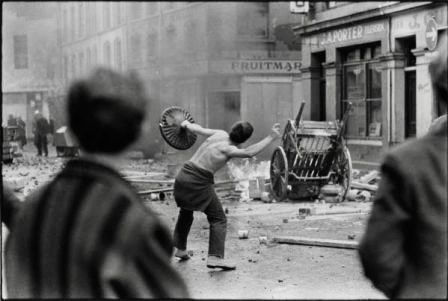
Miraculously no one was killed during the ‘Battle of the Bogside’. It is estimated that over 1,000 people were injured during the three days, including approximately 350 police offers seriously wounded in what was a watershed moment in City that had been bubbling with sectarian violence for years leading up to the 12th of August 1969. It may have been unclear at the time but the ‘Battle of the Bogside’ would be a catalyst for the conflict known as ‘The Troubles’ which would see over 3,000 people from all sides of the conflict lose their lives.


Comments